

Why High Performers Get Overlooked: The Missing Power of Strategic Relationships
Some seven years back, I was coaching a senior leader who wasn’t chosen for a well deserved promotion, which obviously was very disappointing.
Going by the rule book/on the surface, he seemed to be the perfect candidate.
He passed almost all the check marks; exceptional rating, multiple awards, respected by his team, appreciated by his manager, consistent strong results added many feathers to his cap.
Yet, when the promotion decisions were made, someone else got the role.
During one of our coaching conversations, I asked him a simple question:
“How is your relationship with your manager?”
“Excellent,” he replied.
“How is your relationship with your manager’s manager?”
“That too is Very good.”
Then I asked:
And how about the relationships with your manager’s manager’s peers?”
There was a long pause.
“They don’t really know me that well,” he said.
This reply answered all the questions.
Exceptional performance and hard work are still considered to be the sure shot elements required to get a promotion. But that is a partial truth. As one scales up the ladder in an organization, significant decisions related to promotion, assigning critical projects, succession planning, and leadership opportunities are determined by visibility, credibility, and relationships beyond one’s immediate circle.
The panel for promotion discussion often consists of your Manager’s manager and other senior leaders where your manager advocates for your growth. Thus it becomes difficult for them to take the decision in your favor, if they have never interacted with you and don’t know about your capabilities.
This is why strategic relationship building is not politics.
It is leadership.
The Relationship Grid: A Practical Starting Point
The Relationship Grid is one of the best ways to examine and understand the health of your professional network.
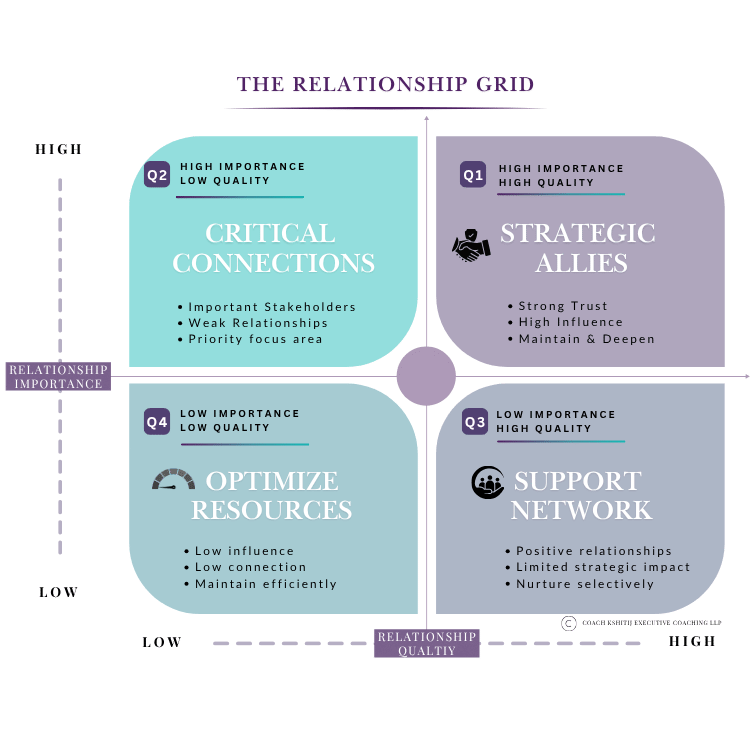
The framework evaluates relationships across two dimensions:
1. Importance of the Relationship: How significant is this person for your career, success, influence, or personal development?
2. Quality of the Relationship: How sturdy, trustful, and constructive is the present relationship with this person?
When you place the prominent stakeholders on these two dimensions, you will find them divided in the following four categories:
Quadrant 1: High Importance, High Quality
These are your strongest strategic relationships.
These relationships ought to be nurtured carefully and must not be taken for granted, as the people in this sphere are the ones who trust you, know your strength and are happy to support you in your journey to success.
A common mistake committed by many leaders is that they focus only on existing relationships and are unable to envision others who may become significant in the future.
Quadrant 2: High Importance, Low Quality
This is the most critical quadrant.
In contrast to their significance, the connections in these relationships are rather weak, inconsistent, or underdeveloped.
Perhaps this could be a senior stakeholder who hardly knows you.
Or maybe it is that cross-functional leader with whom cooperation feels not so easy.
Or it could even be that influential executive whose association could skyrocket your growth.
Evidently, this section must get your maximum attention as it contains the biggest opportunities for leadership growth and career advancement.
Quadrant 3: Low Importance, High Quality
These relationships are pleasant and supportive.
This is that comforting sphere where you enjoy working as a team, and where you have built meaningful connections on the foundation of mutual trust. Although these relationships are responsible for creating a positive work environment, they may not significantly influence your strategic goals.
Undoubtedly, one must nurture such relationships, but be mindful on not investing all your energy in building relations here.
Quadrant 4: Low Importance, Low Quality
These relationships require the bare minimum investment.
Not every relationship needs to become a priority. Effective leaders learn to focus their energy where it creates the greatest impact.
The strength of the Relationship Grid is to aid the leaders to recognize how to mindfully invest in building a relationship.
The Six Building Blocks of Strategic Relationships
The most crucial question that requires an answer after recognizing the relationship that matters the most is:
How do you strengthen them?
Over time, I have observed six fundamental building blocks that consistently create strong professional relationships.
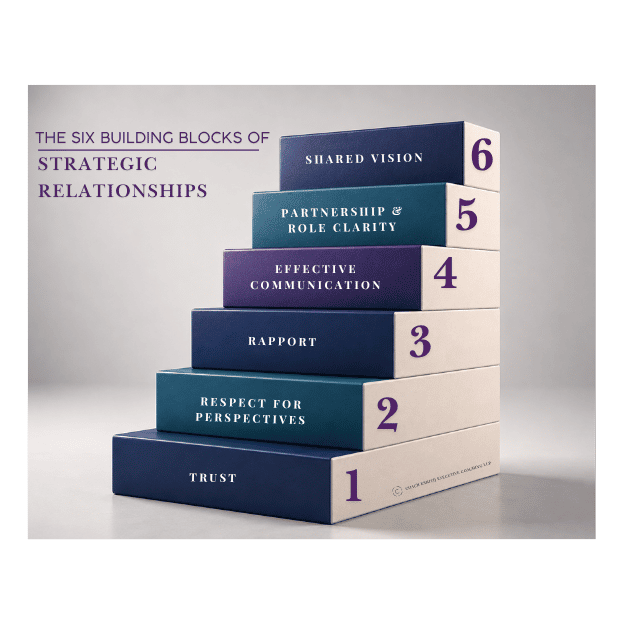
1. Trust
Trust is a cardinal virtue of a leader as it is made by weaving together ‘Faith’ and ‘Conviction”.
Thus you can influence, if you trust.
With trust, teamwork becomes easier.
So, how does one build trust?
Trust is built through consistency, reliability, competence, and integrity.
When your actions and words are in sync, people start trusting you.
Every interaction either strengthens or weakens trust.
There is rarely a neutral moment.
2. Respect for Perspectives
‘Difference of opinion’ is synonymous to ‘Resistance’, is what many leaders believe. But that is great mistake, a folly indeed.
It is a simple thing, people look at situations through different spectrum, based on their experiences, incentives, priorities, and pressures.
So, the basis of a strong relationship is accepting this simple truth and learn to respect other’s viewpoint even though you might not be in agreement with it.
Respect creates openness.
Judgment creates distance.
3. Rapport
Every long term sustainable relationship starts with connection.
Rapport is not about manipulation or networking tactics. It is about creating comfort, familiarity, and genuine human connection.
Where simple conversations matter.
Where the genuine intention to know and understand matters.
Where remembering personal details matters.
A strong connection brings with it trust and unconditional support.
4. Effective Communication
Many of us learned an outdated definition of communication.
The older definition of communication can be misleading.
Traditionally, the act of sharing or exchanging information, idea or feeling, was described as communication.
The modern understanding is more powerful.
Communication is reflected in the response you receive.
So, most of us believe that we communicate very well, but, what if the listener misunderstood, got confused, or took you message differently, that certainly is not effective communication.
The quality of communication is measured by its impact, not just its intention.
5. Partnership and Role Clarity
One of the prime cause of worsening or collapse of a relationship can be, ‘Unclear Expectations’
Who owns what?
Who is responsible for which decisions?
Where do responsibilities overlap?
Vagueness creates friction.
Clarity creates partnership.
A strong relationship is established when both the parties have a clarity of their respective responsibility and they work together toward complementary outcomes rather than competing agendas.
6. Shared Vision
When there is a common goal, a common vision, strong relations are bound to be established.
With the shared goal, efforts are inclined toward resolving conflicts and strengthening collaboration.
Without a shared vision, individuals tend to become inclined towards their own vested interests, which can be detrimental in achieving the goal..
While shared vision fires the progress because of collaborated energy.
So, even before you work on strengthening a relationship ask yourself:
Are we clear about how success would feel like together?
Executive Presence Is Built Through Relationships
When people think about executive presence, they often think about confidence, communication, or gravitas.
Most people associate executive presence with confidence, communication, or gravitas.
And these qualities indeed matter.
However, leadership influence is rarely created in isolation.
Executive presence is reflected in the quality of the relationships you build across your ecosystem.
It is showcased in:
If people have a trust on you.
If they know you.
If they stand for you in your absence.
If they believe that you are capable of operating at the next level.
Most of the successful leaders do not start building relationships, only when they feel the need for support.
They work on them over a period of time in a perpetual, thoughtful and strategic way.
So pause for a moment today.
Draw your own Relationship Grid.
Recognize the people who matter most.
Do a quiet introspection and identify the relationships which are of utmost importance but presently are low in quality
That quadrant may contain the single biggest opportunity for your next level of leadership growth.
Because careers are rarely accelerated by performance alone.
They are accelerated by performance combined with strong, trusted, strategic relationships.